
Gallery-grade art documents
in under two minutes.
Certificates of authenticity, customs invoices, provenance, appraisals, condition reports and 10 more. Every one comes from a single artwork entry. Print-ready, in your gallery branding, with an HS code classified from the medium you typed and no code at all where it cannot be classified.
We built this after our gallery spent $400 on a designer for a single certificate of authenticity. Now it takes two minutes.
Gallery-grade output.
In under two minutes.
Every document opens print-ready in your browser with your gallery branding, an HS code classified from the medium you entered, and page furniture set for A4, US Letter, A3 or A5. Print it, or save it as a PDF from the print dialog.
Art paperwork is still done by hand.
Your credibility pays for the mistakes.
Emerging artists lose sales because they lack professional certificates of authenticity. Galleries assemble customs paperwork by hand, in Word or InDesign, for every international shipment. A line with no HS code on it is a line a customs officer stops to ask about. A dimension typed twice is a dimension typed differently.
One platform. Every document.
Gallery-grade in under two minutes.
Gilded Art Works generates certificates of authenticity, customs documentation with auto-classified HS codes, branded gallery brochures, provenance records, condition reports and 10 more document types, all from a single artwork entry. Your gallery branding, one classification decision per line, and print-ready formatting, every time.
What a gallery gets back
The paperwork stops being a project
The documents that used to mean a designer, a brief and a wait now come off an artwork entry you have already made. Nobody blocks a shipment waiting for a file.
Every document says the same thing
Title, medium, dimensions, declared value and HS code are entered once and appear identically on the certificate, the customs sheet and the packing list. The mismatch that holds a crate at the border is a transcription error, and there is nothing left to transcribe.
You can answer a collector on the spot
A certificate, a provenance record and a condition report exist before the question is asked. The collector can verify the work themselves, without emailing you and waiting.
Create professional art documents in three steps
Enter Your Artwork Details
Add the title, artist name, medium, dimensions and year. Upload a high-resolution image. Set up your gallery or artist profile once. Gilded Art Works remembers it for every future document.
Select Your Documents
Choose from 15 document types. Certificates of authenticity, customs technical sheets, branded brochures, provenance records, condition reports and appraisals are six of them. Generate one or all at once.
Open, Print & Ship
The finished document opens in a new tab, set for A4, US Letter, A3 or A5 with your branding and the HS code on every line. Print it, or save it as a PDF from your browser's print dialog, and include it with the shipment or the collector package.
Every document artists, galleries & dealers need
Editorial Catalog
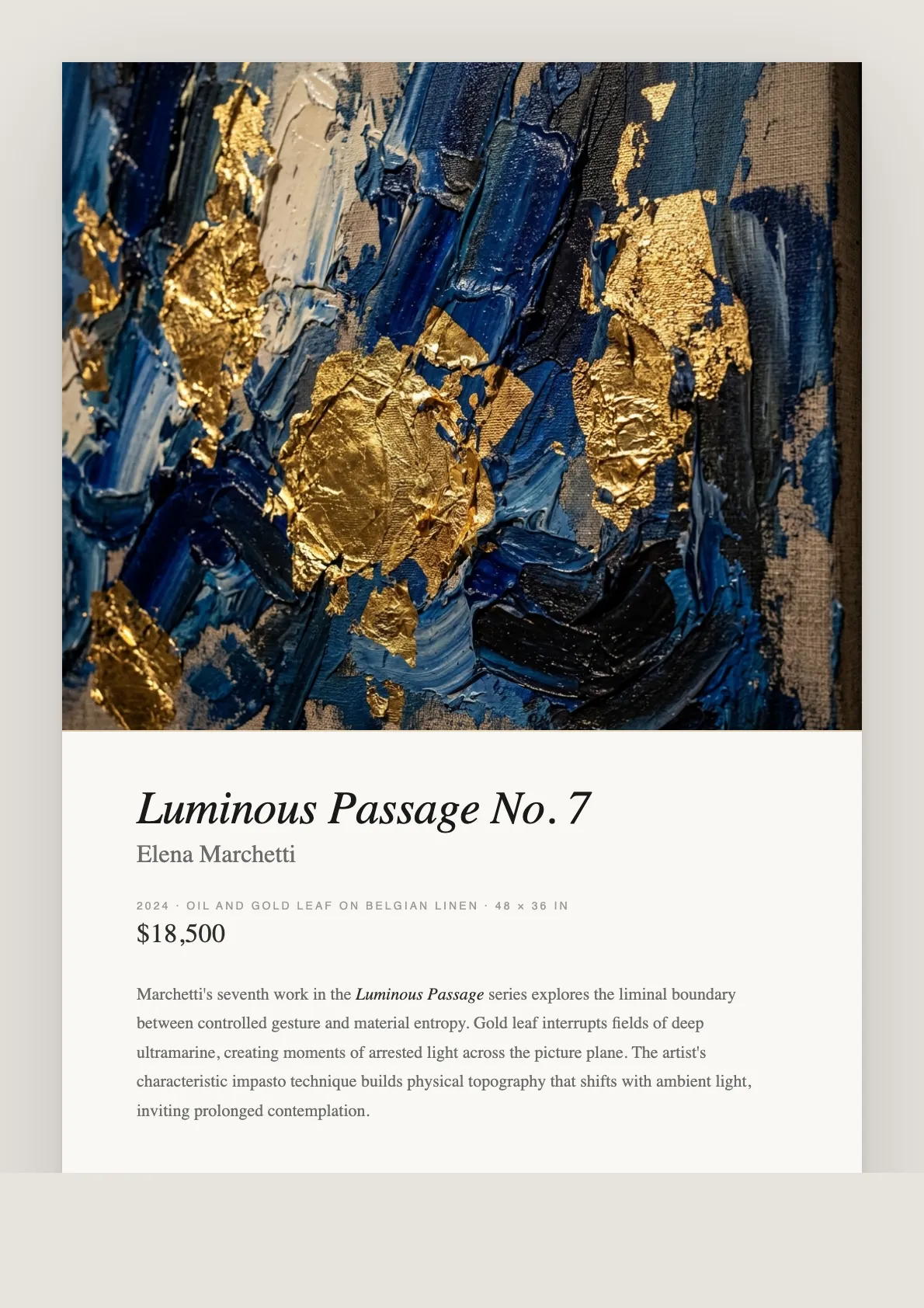
A branded catalog page: a masthead in your identity, then every work set as a ruled entry with its image, medium, dimensions and price.
- Masthead with gallery logo, artist or exhibition name and date
- One ruled entry per work, with a 120 × 90 image
- Price omitted where no price is entered
Customs Documentation
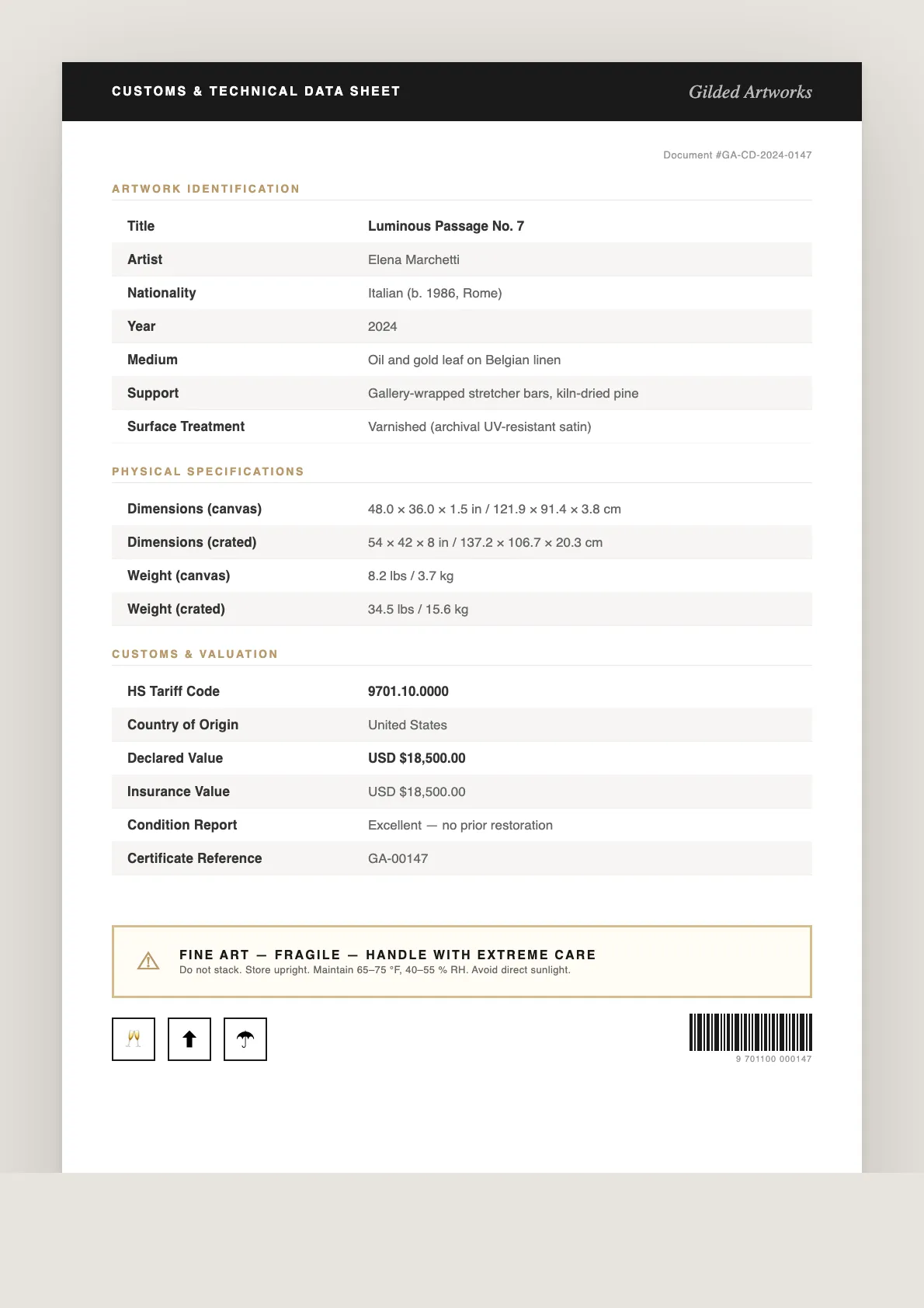
A commercial invoice for fine art: shipper and consignee blocks, one row per work, and an HS code classified from the medium you entered.
- HS code classified per line from medium and year
- Unrecognised media print review, never a guess
- Declared-value total over a signed declaration
Certificate of Authenticity
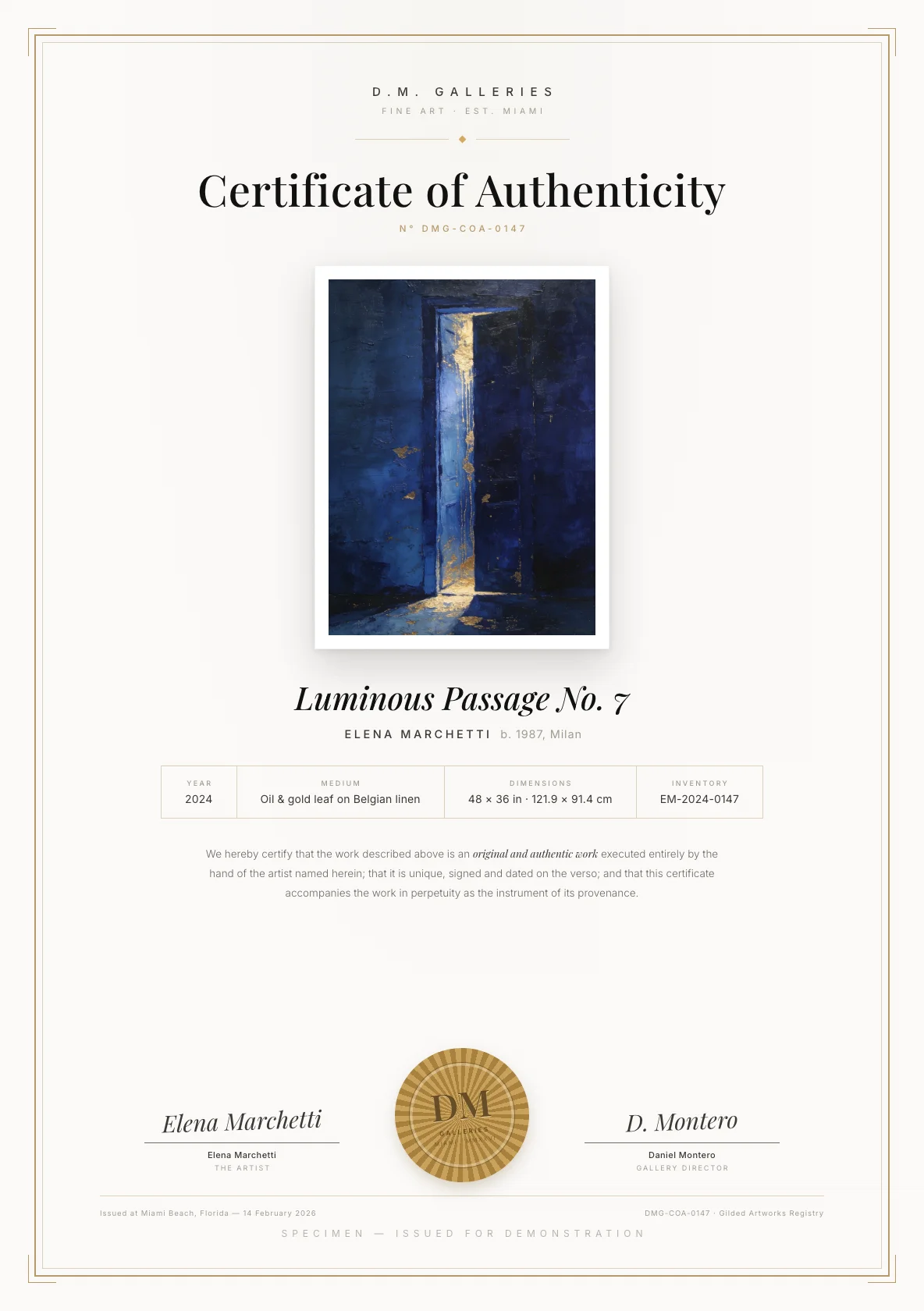
The artwork image on the face, every work described in full, and a fixed attestation of originality under a unique document number.
- Document number in the form GA-2026-<twelve hex characters>
- Artist, title, year, medium and dimensions per work
- One signature line for your authorized representative, with seal
Bill of Sale
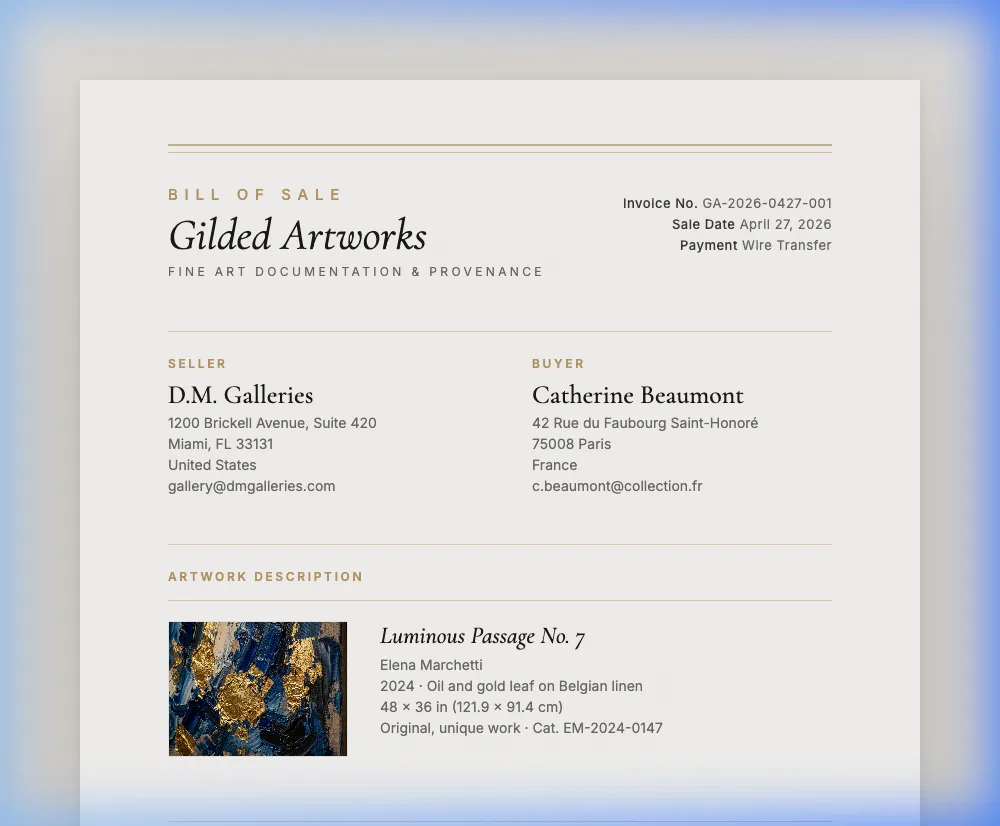
A sales receipt recording the transfer of ownership, with the works itemised to a total and both parties' signature blocks.
- Itemised table with a total purchase price
- Seller block filled from your gallery profile
- Buyer block left open, completed at signing
Condition Report
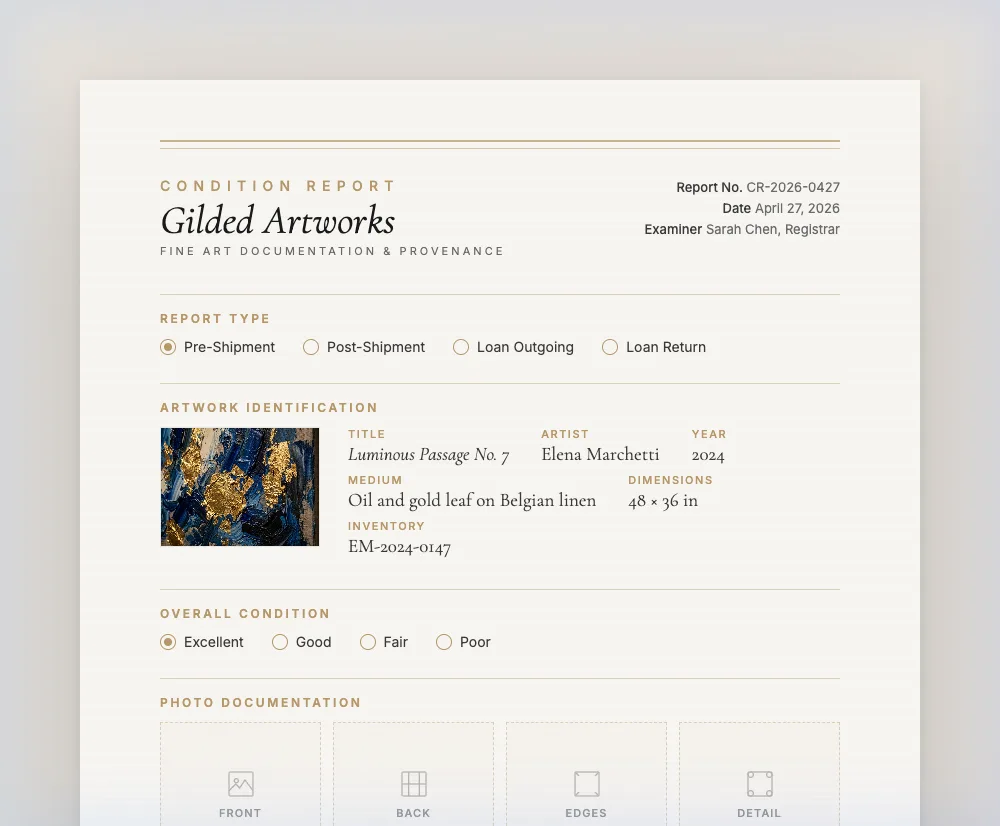
A ten-point examination form with report-type and overall-grade selections and a panel for the examiner's written findings.
- Report type: pre- or post-shipment, loan out or return
- Ten-point grid: surface, support, frame, hardware, damage
- Examiner notes panel over two signature lines
Provenance Record
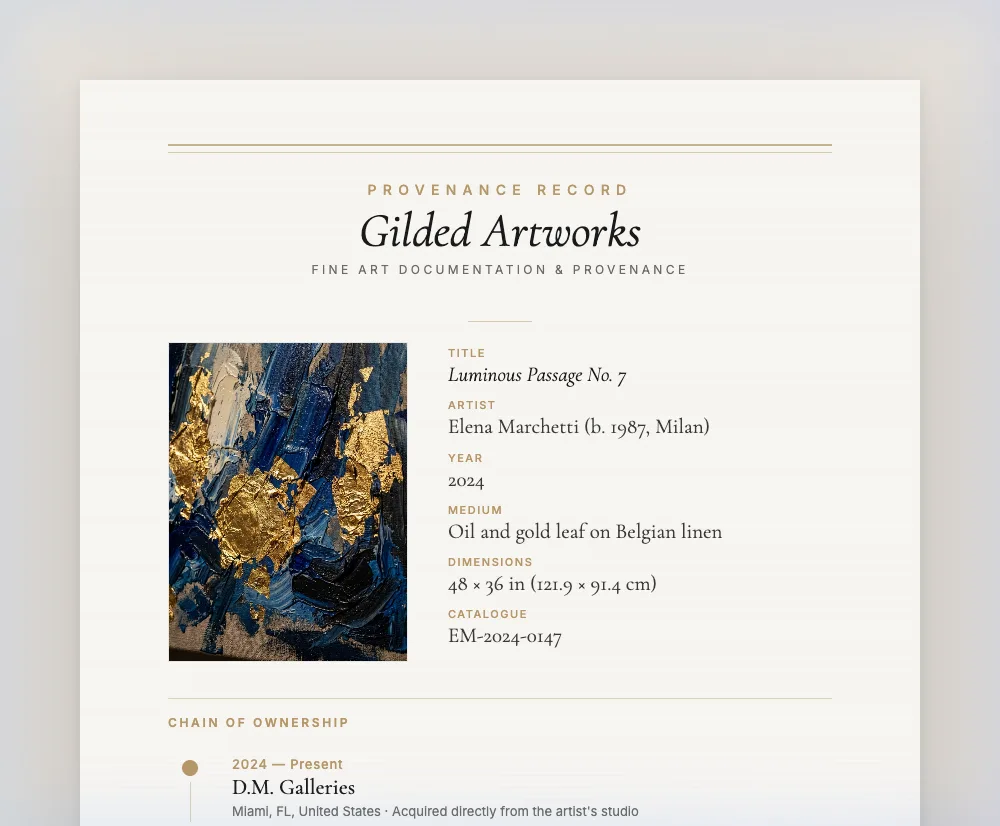
A structured ownership register. It records the current custodian and carries a standing note that the rest of the chain is the registrar's to add.
- Period, owner, location, acquired from, notes
- Current custodian entered from your gallery profile
- A closing line leaving the rest to the registrar, never invented
Consignment Agreement
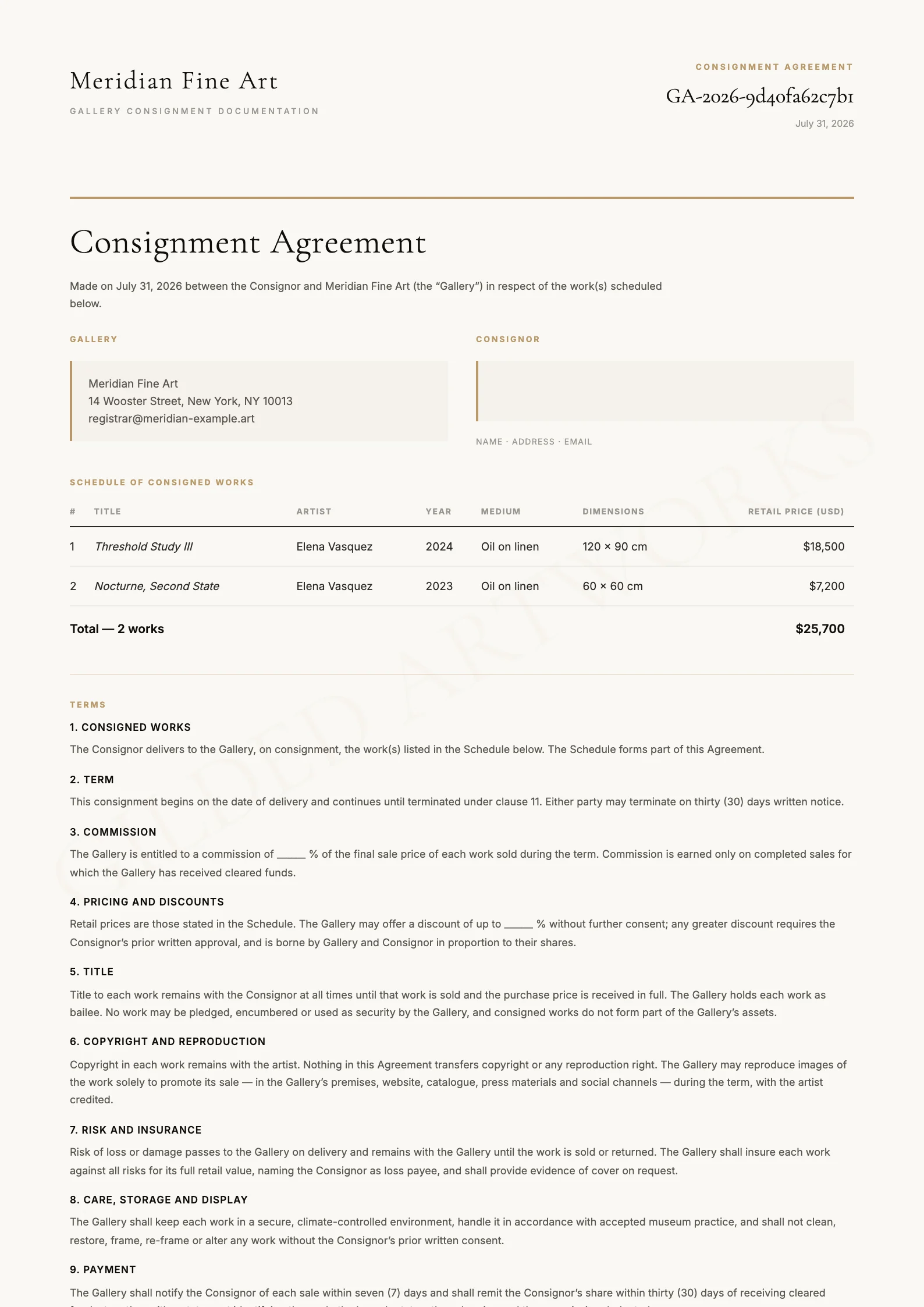
A twelve-clause contract with a schedule of works, drafted so that title and copyright both stay with the consignor.
- Schedule of works with retail prices and a total
- Twelve numbered clauses, printed in full
- Blanks for commission, discount authority and governing law
Insurance Certificate
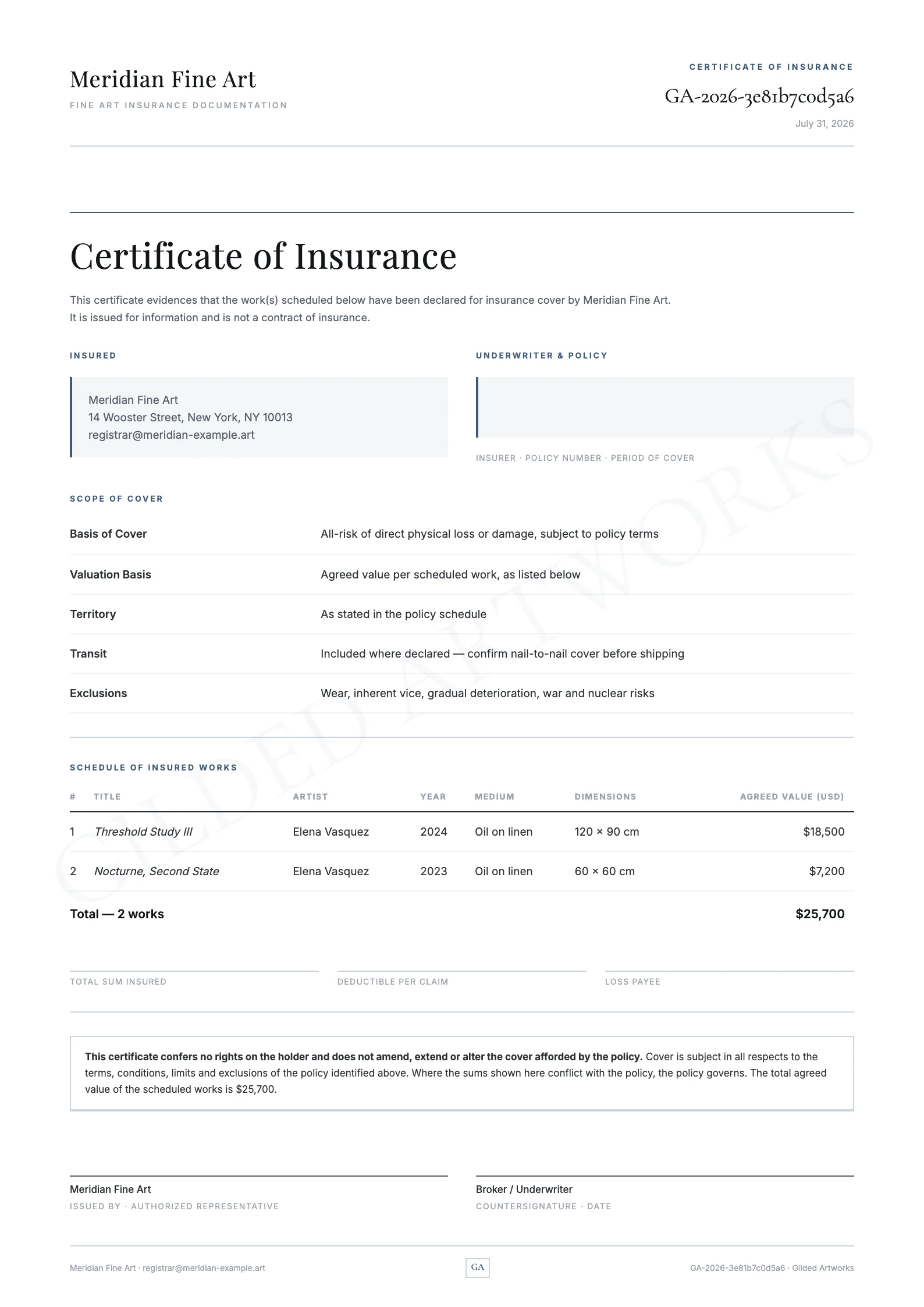
Evidence of cover arranged elsewhere, over the declaration that it confers no rights on the holder and cannot amend the policy.
- Scope of cover: basis, valuation, territory, transit, exclusions
- Schedule of insured works with agreed values
- Three ruled blanks (sum insured, deductible, loss payee) plus an empty underwriter box
Appraisal Report
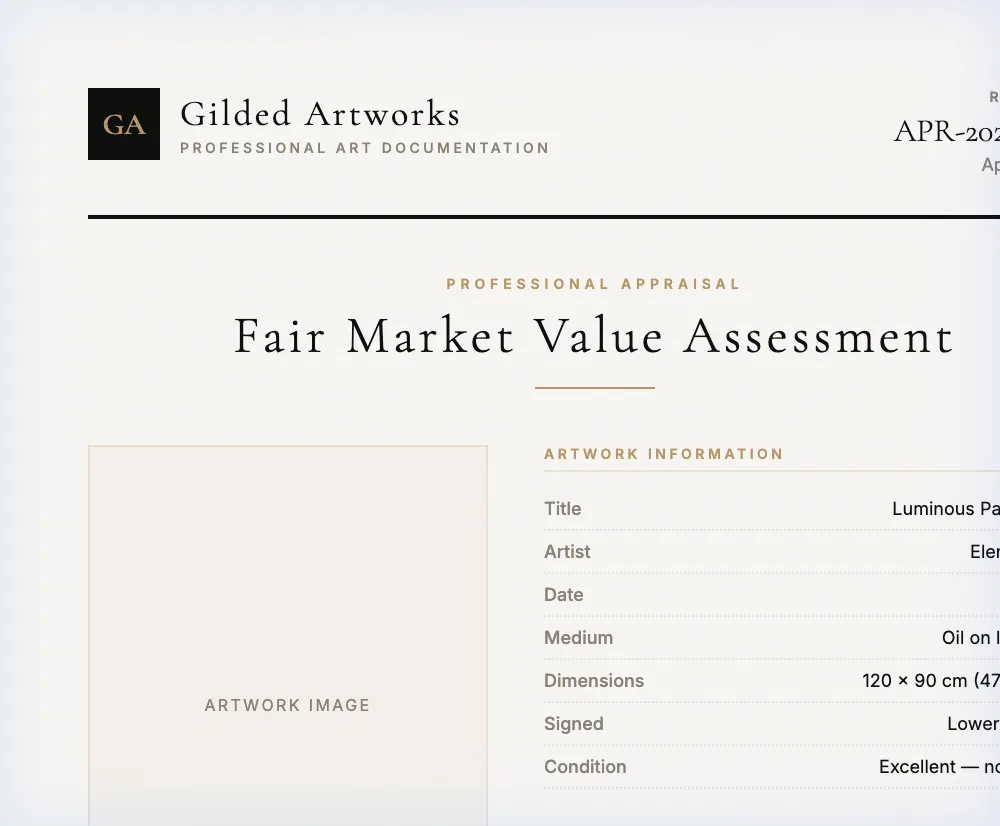
A valuation sheet presenting an appraiser's figures: one per work, on a fair market value basis, over their signature and the date the sheet was issued.
- Purpose statement: insurance, estate, tax or sale
- One figure per work, captioned Fair Market Value, plus a total
- No comparables or methodology: that is the appraiser's report
Loan Agreement
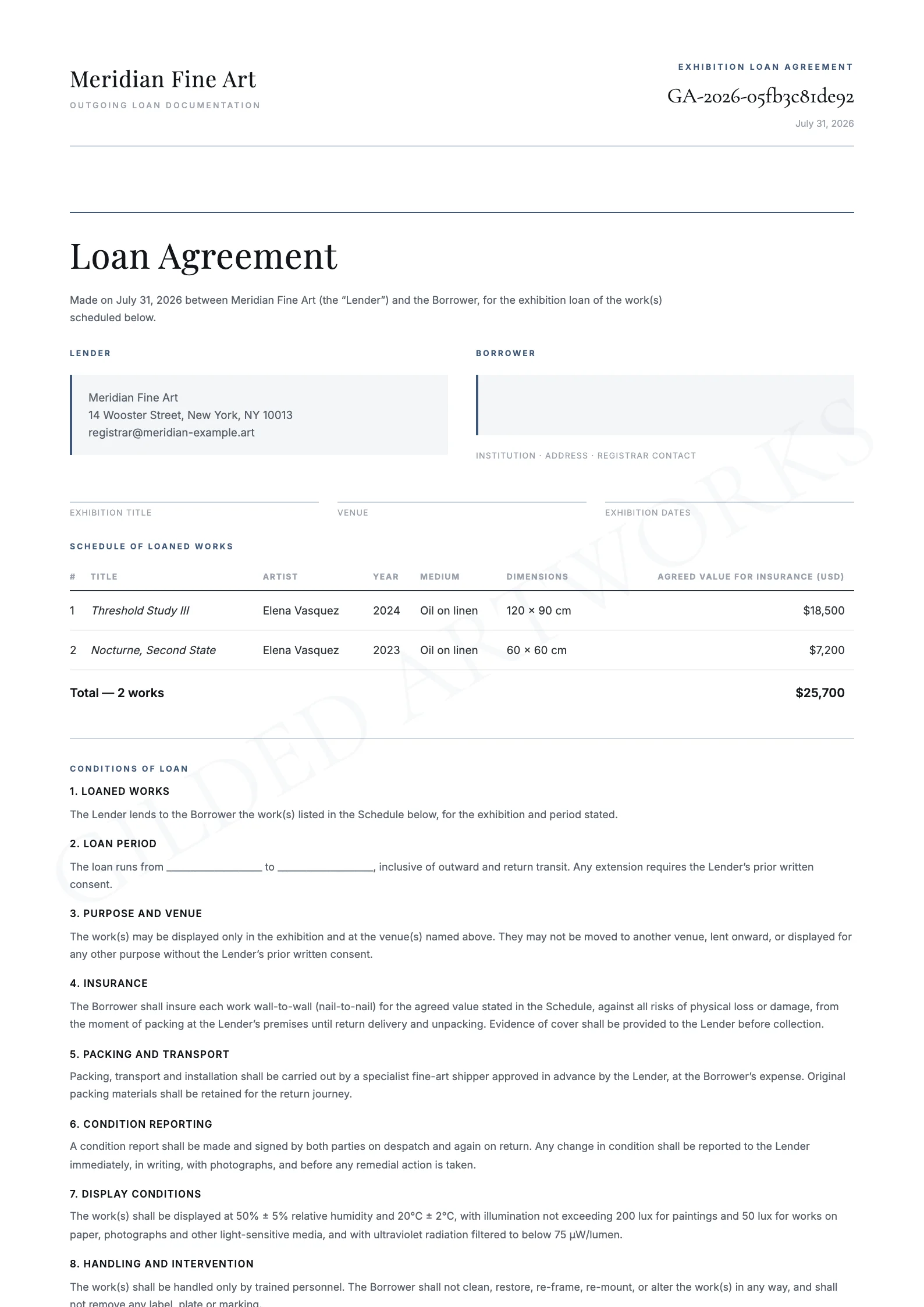
An outgoing exhibition loan contract that puts the environmental limits, the insurance basis and the borrower's liability in writing.
- 20°C ± 2°C, 50% ± 5% RH, 200 lux (50 lux for light-sensitive media)
- Wall-to-wall insurance placed on the borrower
- Condition reports required on despatch and on return
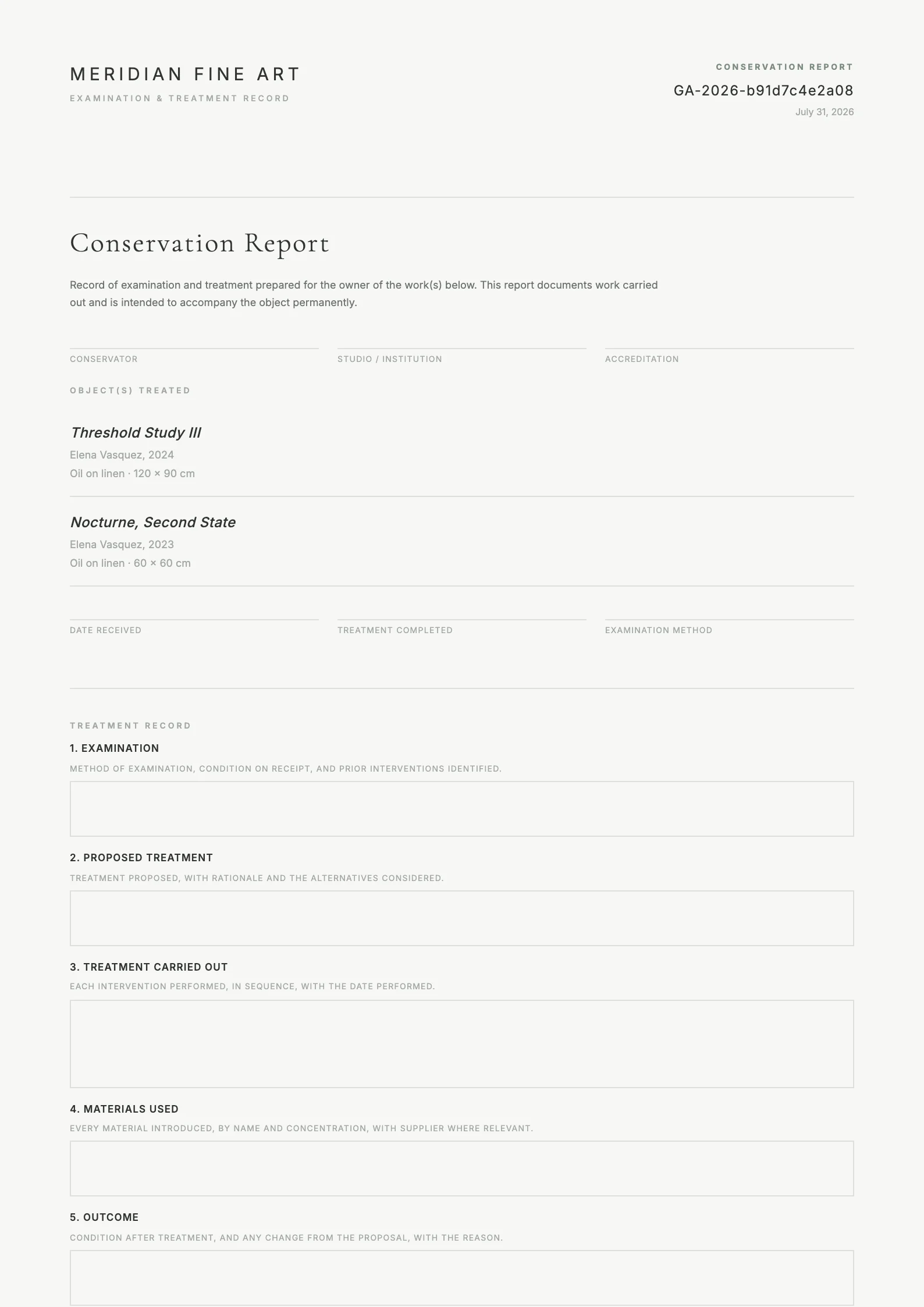
Conservation Report
A six-part treatment record (examination through aftercare) under a reversibility declaration, written to travel with the object.
- Six ruled sections, each with a written prompt
- Blanks for conservator, studio and accreditation
- States expressly that it is no opinion on authenticity or value
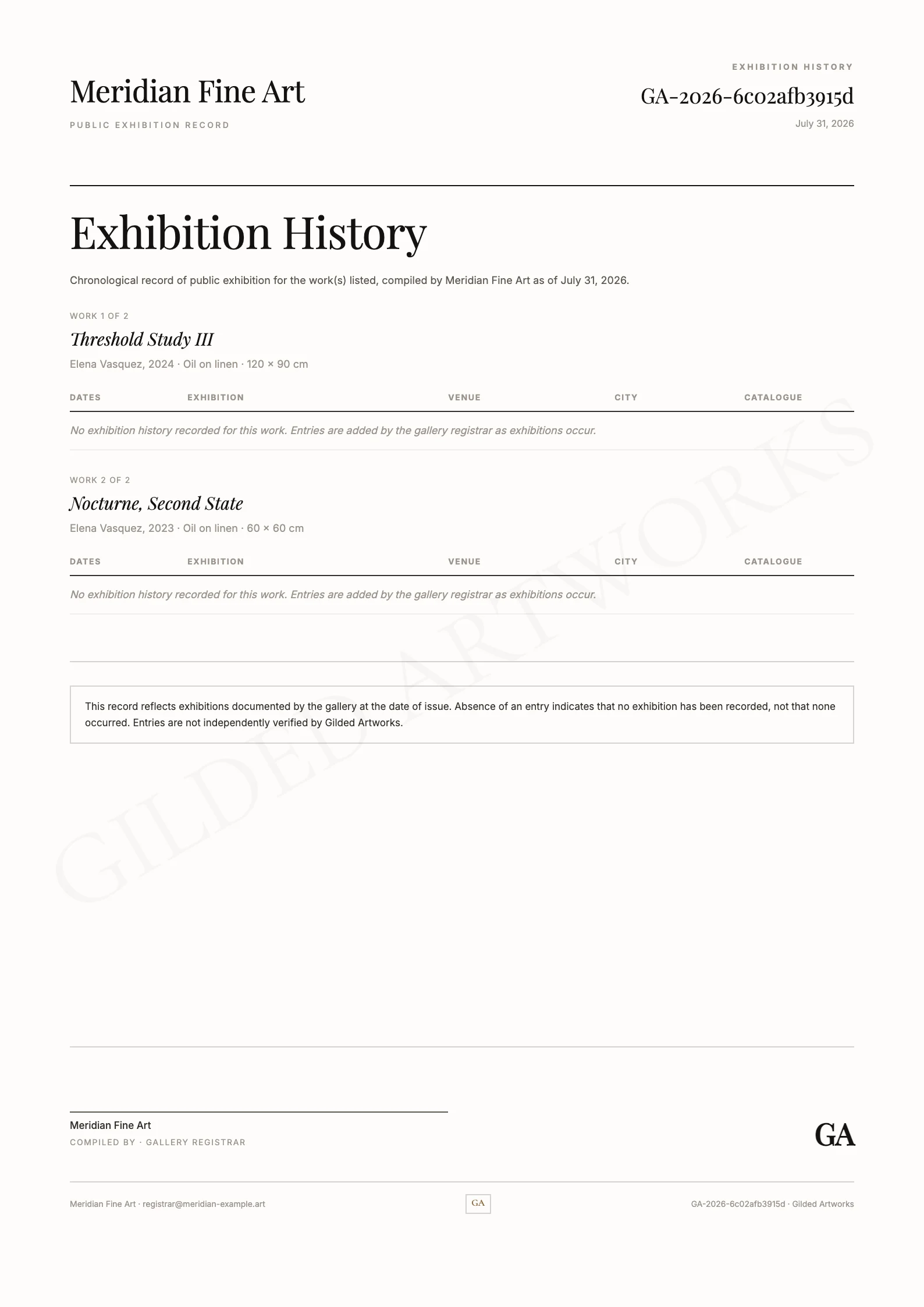
Exhibition History
A per-work register with dates, exhibition, venue, city and catalogue columns, and an empty state that says so in plain language.
- Five-column register, one block per work
- A standing row stating that no exhibition history is recorded
- Compiled-by signature; entries are not independently verified
Artist Statement
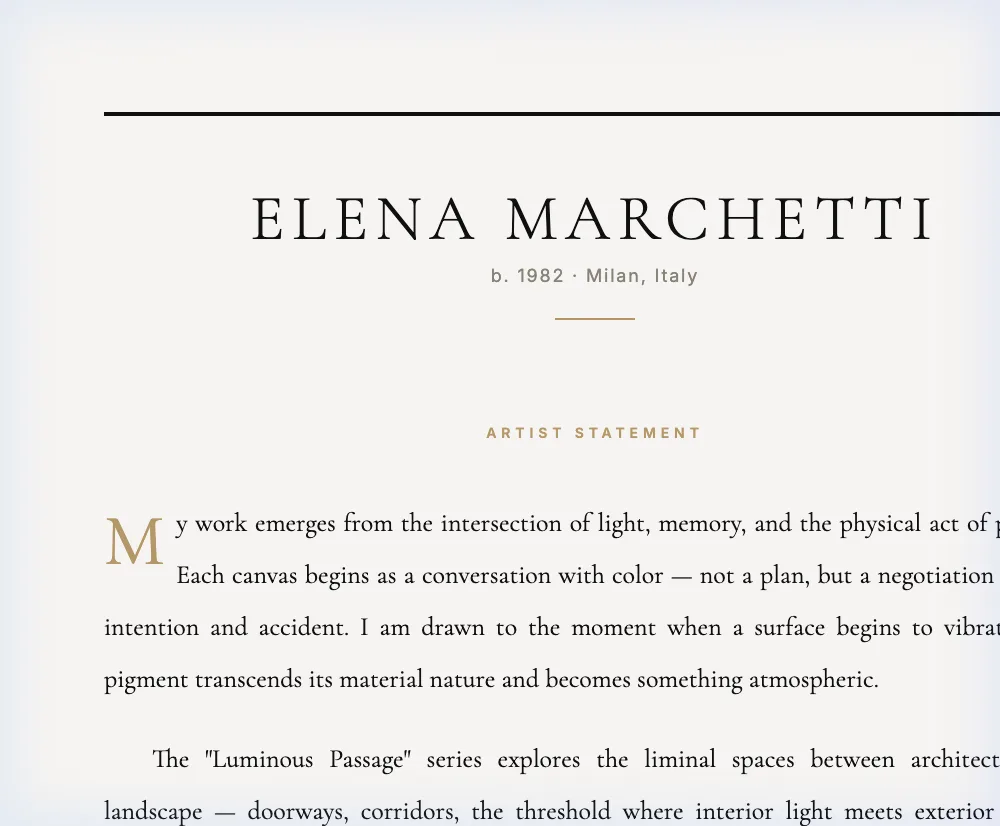
A single editorial page with ruled sections for the statement, biography, exhibitions and collections. You write the words; the page is already set.
- Editorial typography, one page
- Ruled sections for biography, education, exhibitions, collections
- Works-referenced list from your entries, up to six
Artwork Passport
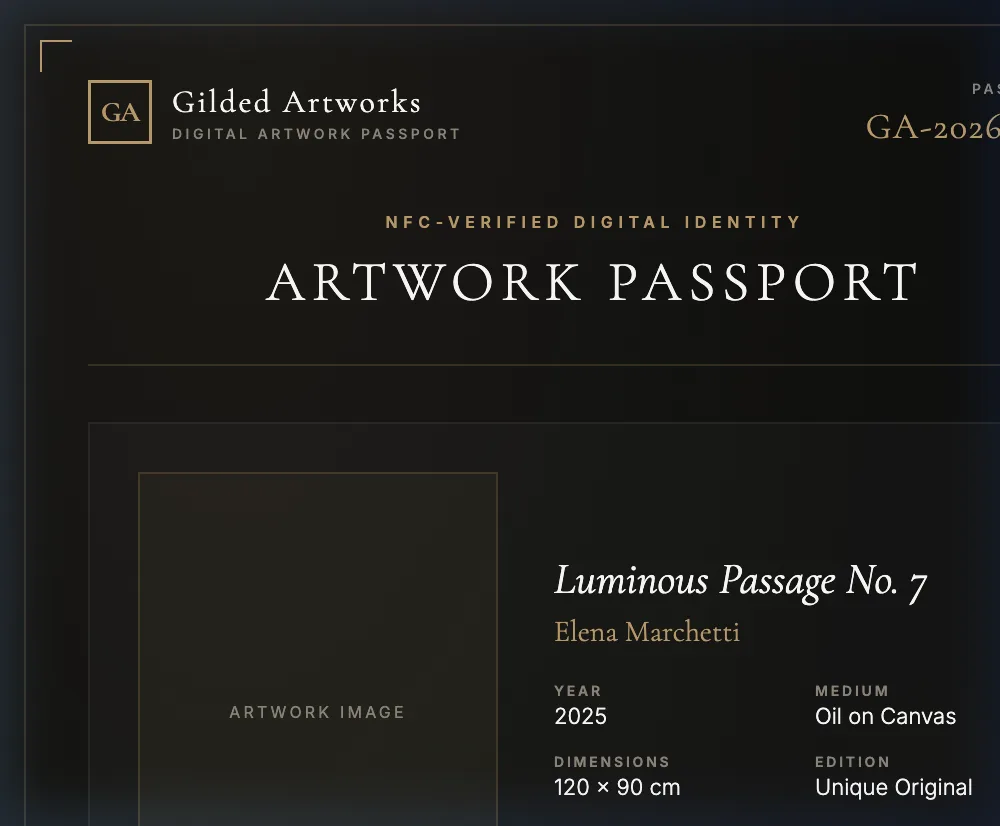
A printed identity record for the work, paired with a public verification page that an NFC tag on the object resolves to.
- Registry number, status band, image and full description
- NTAG 424 DNA tags, with the signature on each tap recomputed server-side
- Public verification page at /verify; no QR code is generated
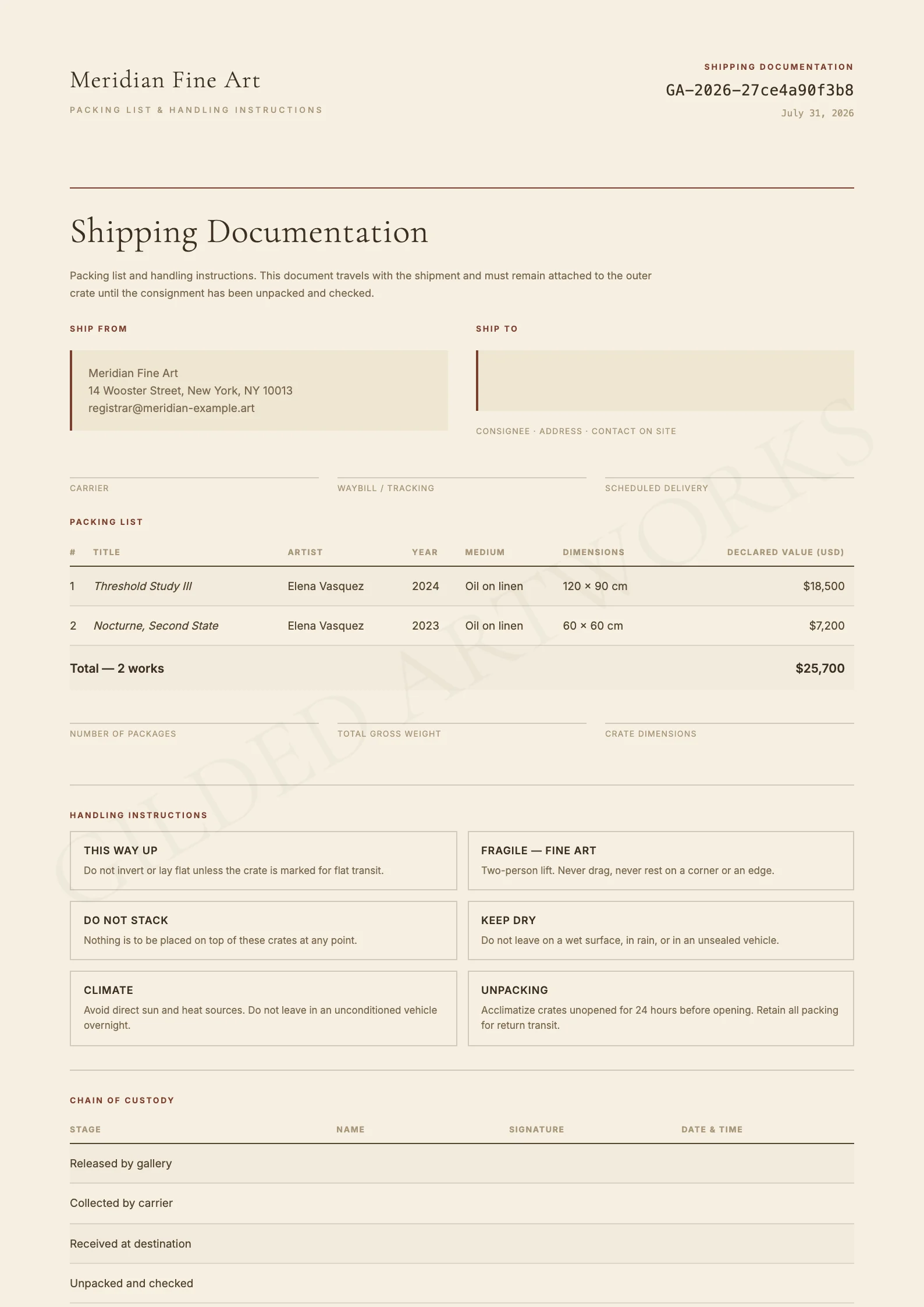
Shipping Documentation
The packing list, handling instructions and chain-of-custody grid that travel attached to the crate, built from the same record as the customs paperwork.
- Packing list with declared values
- Six boxed handling instructions, printed on every copy
- Chain-of-custody signatures at each handover
See what you'll create
Get told when the next guide publishes
We write one when we hit something worth documenting, like customs, provenance or insurance. No schedule, no drip sequence, and the guides stay free to read whether or not you leave an address.
What sits around the paperwork
Carrier Rates & Labels
Built to price and book UPS, FedEx and DHL beside the customs paperwork. The carrier connection is not switched on yet. The shipping documents themselves generate today.
NFC Verification
Every artwork gets a public registry entry at /verify, readable without a login. Fit an NTAG 424 DNA tag and each tap is signed by the chip and recomputed server-side. A matching signature reports a verified read; anything else currently reports as not verifiable rather than as a forgery, because no provisioned tag has been tested against this code yet. The platform does not generate QR codes.
Developer API & Webhooks
The HTTP endpoints behind the app are documented at /developers, along with the webhook events and signing. They authenticate with your browser session today, so external integration is not open yet. The reference is there so you can see the shape of it and tell us what you need to connect.
Gallery Teams & Roles
Invite your team as Viewers, Editors or Admins, with role-based access control across every document and shipment.
Bulk Generation
Select works from your library and generate the document types you need across all of them in one pass: one document per type, covering every work you selected. The batch API takes up to 50 operations per request.
Compliance Audit Trail
A timestamped activity log for every document generated, team action and verification read. Entries are written by the platform and are read-only to your account. Nothing in the app edits or deletes them.
Common questions about art documentation
What is Gilded Art Works?
Gilded Art Works is an art documentation platform. It generates certificates of authenticity, commercial invoices for customs, provenance records, gallery brochures, condition reports, appraisals and 9 more document types. It is built for galleries, dealers, collectors and emerging artists who need gallery-grade documentation without hiring a designer or consultant.
How do I create a certificate of authenticity for my artwork?
Enter your artwork details (title, artist, medium, dimensions, year) and upload a high-resolution image. Select "Certificate of Authenticity" from the document menu. Gilded Art Works generates a COA carrying a unique document number, the artwork image on the face, the full description of every work listed, a fixed attestation of originality, and one signature line for your authorized representative. It is print-ready in under two minutes. Edition information goes in the medium field, since the artwork record has no separate edition field.
What documents do I need for international art shipping?
International art shipments typically require: a commercial invoice carrying HS codes and declared values, a certificate of authenticity, a condition report documenting the artwork's state before shipping, a packing list, and optionally a gallery brochure or editorial catalog for the recipient. Gilded Art Works generates all of these from a single artwork entry. Each carrier sets its own filing requirements and its own forms; check the current terms for the service you are booking, and file the entry through your broker.
What are HS codes for artwork, and does Gilded Art Works include them?
HS (Harmonized System) codes are international tariff classification numbers required for customs clearance. Hand-executed paintings, original prints and sculpture sit in Chapter 97 (9701.10, 9702.00, 9703.00), but photographs sit in Chapter 49 under 4911.91 and reproductions under 4911.99. Galleries lose money on that distinction regularly. Gilded Art Works proposes a code per line from the medium and year you entered, drawing on ten codes in total. Where the medium matches none of them, the line prints review and carries no code, and the declaration tells you not to sign until your broker has resolved it. You sign the declaration, so read every line first.
Is Gilded Art Works free for emerging artists?
There is a free plan, Essentials, and it needs no credit card. It allows three documents a month (any three of the fifteen types, including certificates of authenticity, artist statements and customs invoices) and does not include the artwork library. A fourth document in the same month is refused until the next one begins. Professional and above lift the monthly limit and add the library.
What is art provenance and why does it matter?
Provenance is the documented ownership history of an artwork, from the artist's studio through every subsequent owner, exhibition and sale. Authenticity, fair market value and compliance with international art trade regulations all rest on it. Gilded Art Works prints the register that holds it (period, owner or custodian, location, acquired from, notes), opened with your gallery as current custodian and closed with a line stating that the earlier entries are your registrar's to supply. It does not research provenance, and exhibition history is a separate document type.
Your art deserves professional
documentation. Start free.
No credit card required. Create your first certificate of authenticity, customs invoice or gallery catalog in under two minutes. Any of the 15 types, three documents a month, on the free Essentials plan.