Document Type
Appraisal Report
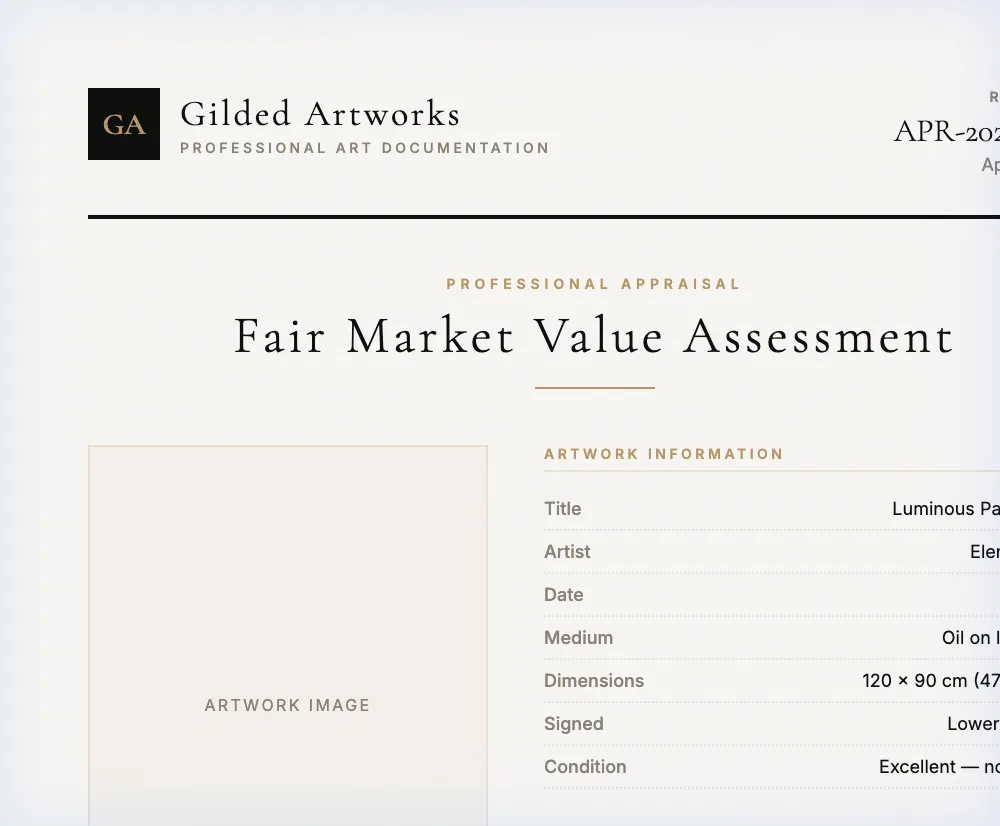
A valuation is only as good as the person who signs it, and the document’s job is to present that opinion clearly enough to be relied on. Gilded Art Works sets the sheet: a statement of the purpose the valuation was prepared for, each work with its image and full description alongside its appraised figure on a fair market value basis, a total across the works, and a signature line and date for the appraiser.
Best for: Appraisers who want their analysis presented as a document rather than a spreadsheet, and galleries preparing figures for an insurer or an estate.

What’s in the document
- Purpose statement — insurance, estate, tax or sale — printed at the head
- Each work with its image, title, artist, year, medium and dimensions
- Appraised figure per work, presented on a fair market value basis
- Total portfolio value across the works appraised
- Appraiser signature line, dated with the date the sheet was generated
- Document number and date of issue in the header; number again in the footer
Who may appraise, and why the distinction is strict
An appraisal is a professional opinion of value, produced by someone whose qualifications and independence can be examined. That is why the field is governed by standards — USPAP in the United States, comparable frameworks elsewhere — and why an appraisal produced by an interested party is discounted or rejected outright. A gallery valuing work it is trying to sell is an interested party.
The practical consequence is that this document is a presentation layer for an appraiser’s work, not a substitute for it. Where a valuation is going to an insurer, an estate, a court or a tax authority, the question they will ask is who signed it and on what basis — and no software can answer that question on your behalf.
What the sheet sets out
The layout is spare, and everything on it derives from the artwork records you supply.
- Purpose statement
- Printed under the title: that the valuation is prepared for insurance, estate, tax or sale purposes, and that values reflect market conditions as at the date of appraisal. Purpose is not a formality — the same object carries different figures depending on the question being asked, and a report that does not state its purpose invites the wrong number to be reused.
- The works
- Each work prints with its image and its full description — title, artist, year, medium, dimensions — beside its appraised figure. The figure is captioned Fair Market Value: the price between a willing buyer and a willing seller, neither under compulsion, both reasonably informed.
- The portfolio total
- Summed across the works appraised and set below a double rule. Useful for a schedule or an estate inventory; not a substitute for the per-work figures, which are what any reader will actually work from.
- Signature and date
- One signature line labelled Certified Appraiser, printed with the date the sheet was generated. Read that as an issue date, not as an effective date: the effective date is the date the values speak to, and only the appraiser can state it. Where the two differ — a valuation made in March and typed up in June — write the effective date on the sheet beside the signature, because it is the first thing a reviewer checks and the sheet does not print it for you.
What a complete appraisal needs that this sheet does not print
Say this plainly rather than discovering it at review. A report intended to satisfy a professional standard generally needs more than a figure: an identification of the client and the intended users, a statement of the intended use, the value definition being applied and its source, the approach and methodology used, the comparable sales relied on and why they are comparable, the appraiser’s qualifications and their statement of independence, the scope of work performed, any extraordinary assumptions, and a signed certification. None of that is printed here.
So use this sheet as the presentation of the valuation and attach the analysis behind it, or have your appraiser produce their full report and use this as the summary schedule that travels with it. Where the report is going to a tax authority — a charitable-donation appraisal in the United States, for example — the requirements are specific, they change, and confirming that the report meets them is your appraiser’s responsibility, not the software’s.
What it does not do
Gilded Art Works does not appraise. The figure printed on each line is the price on your artwork record, formatted and captioned; nothing values, verifies or reviews it, and no market data is consulted. The sheet prints one figure per work rather than separate fair market, replacement and marketable cash values. It carries no comparable-sales section, no methodology statement, no appraiser credentials block and no certification, and it does not print an effective date distinct from the date it was generated. And it is not qualified by anyone: the opinion is the signer’s, and so is the responsibility for it.
Questions, answered
Does Gilded Art Works perform the appraisal?
No. Value opinions come from qualified appraisers. The figure on each line is the price you entered on the artwork record, formatted and captioned as fair market value. Nothing here values, verifies or reviews it, and no market data is consulted.
What value basis does the sheet use?
Fair market value — the price between a willing buyer and a willing seller, neither under compulsion and both reasonably informed. It prints one figure per work. If your report needs replacement value or marketable cash value as well, those belong in the appraiser’s own report alongside this schedule.
Does it include comparable sales and methodology?
No. There is no comparables section, no methodology statement, no credentials block and no signed certification. A report intended to meet a professional standard needs all of those; produce them as the appraiser’s report and use this sheet as the summary schedule that travels with it.
Can I use this for an IRS charitable donation appraisal?
Not on its own. "Qualified appraisal" and "qualified appraiser" are defined terms that concern the appraiser and the content of their report, not the software that sets it. The requirements are specific and they change; confirming that a report meets the current ones is your appraiser’s responsibility.
Why does the purpose statement matter?
Because the same object carries different figures depending on the question asked — an insurance schedule, an estate inventory and a sale each want a different number. A report that does not state its purpose will have the wrong figure reused from it, usually by someone acting in good faith.
Also in the library
Your first appraisal report is free.
One artwork entry, any of the 15 document types. Three a month on the free plan, no card required.
Create Your First Document — Free