Document Type
Certificate of Authenticity
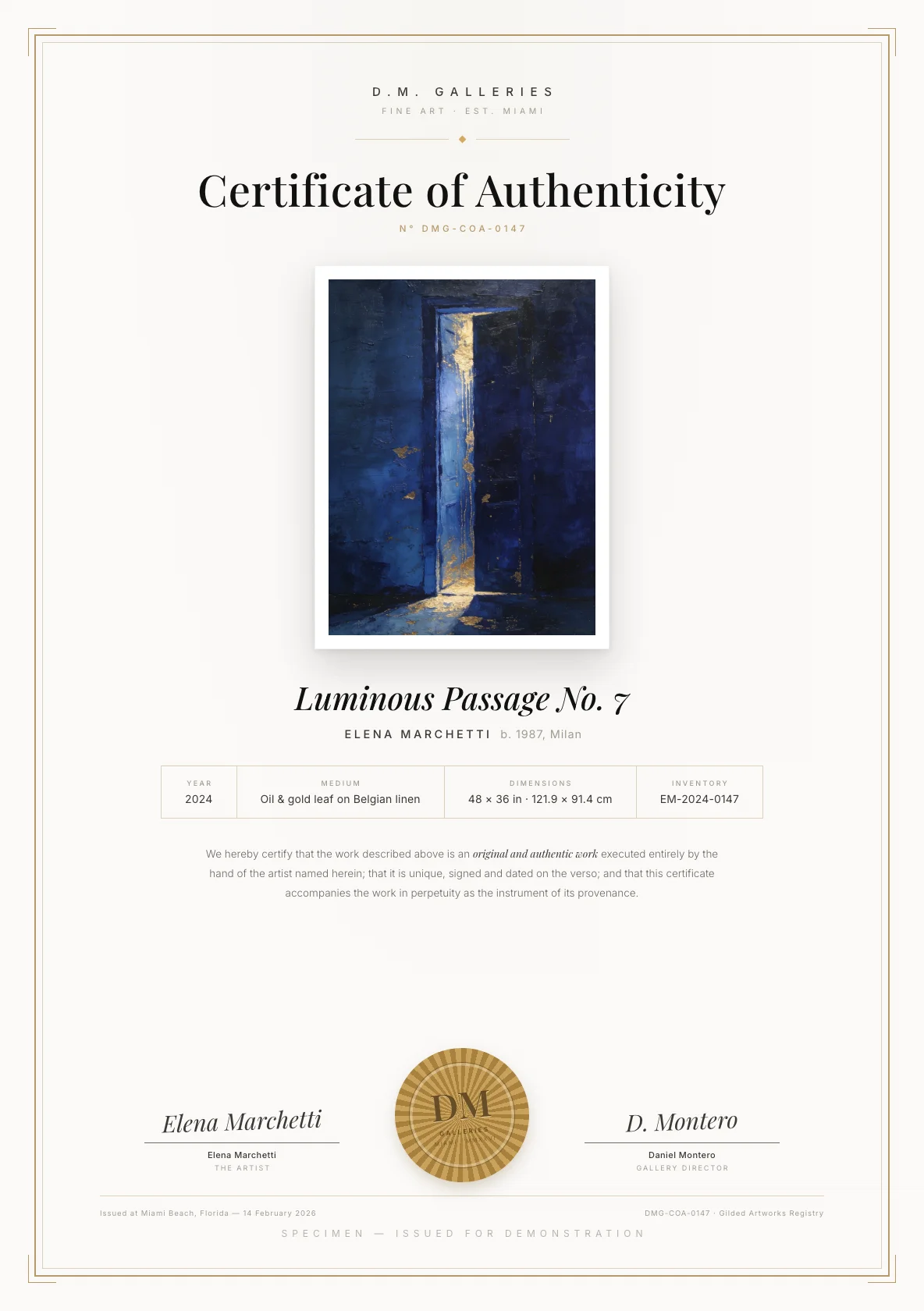
A certificate of authenticity is written at the moment of sale and read decades later by someone who cannot ask you anything. Gilded Art Works lays one out to that standard: the artwork image on the face, the full description of every work listed, a fixed attestation of originality, and a signature line for your authorized representative — all issued under a document number generated for that certificate alone.
Best for: Galleries issuing a certificate with every sale, and independent artists who need collector-grade documentation without hiring a designer.

What’s in the document
- Unique document number per certificate, in the form GA-2026-<twelve hex characters>
- The artwork image printed on the face of the certificate
- Artist, title, year, medium and dimensions for every work listed
- Fixed attestation of originality and of the certificate accompanying the work
- Signature line for your authorized representative, with gallery seal
- Decorative double border and corner rules; eight document designs
- A4, US Letter, A3 or A5 — print-ready, printed or saved as PDF from the browser
When a certificate is expected
No statute obliges a private art sale to carry a certificate. Three parties ask for one anyway, as a matter of course: the collector’s insurer when the work is scheduled onto a policy, the auction specialist assessing a consignment years later, and the executor handling the work when it passes through an estate. All three want the same thing — a contemporaneous document, issued by the party in a position to know, describing the work precisely enough that it cannot be confused with another.
That is the whole design brief, and it explains why certificates fail. The person reading yours in twenty years cannot email you a question. Anything left out becomes a question with no answer: whether "print" meant a hand-pulled etching or a pigment print, whether the dimensions are sight size or overall including the frame, which of two works with the same title this one is.
What the certificate carries, field by field
Each certificate is assembled from one gallery record and one or more artwork records. Nothing is inferred and nothing is filled in on your behalf.
- Document number
- Generated at the moment of output, in the form GA-2026- followed by twelve hexadecimal characters. It is the handle for this certificate in your own records and in any later correspondence about it. Two certificates for the same work — a replacement, a reissue after a correction — carry different numbers, which is how you tell them apart.
- The image on the face
- The artwork photograph prints on the certificate itself, above the title. A certificate that describes a work without showing it asks the reader to take the description on trust; one that shows it can be held up against the object.
- Artist, title, year, medium, dimensions
- Printed for every work on the certificate. Medium is free text, and it is where edition information belongs — write "Archival pigment print, edition 3 of 12" rather than expecting a separate edition line, because the artwork record has no separate edition field. Dimensions are equally free text, so state your convention there: height × width, and whether the figure includes the frame.
- The attestation
- Fixed text, printed on every certificate: that the works listed are original and authentic, created by the artists named, and that the certificate accompanies the work and confirms its provenance. It is not editable per certificate, which is deliberate — the sentence you sign should not drift from sale to sale.
- One signature line
- Labelled Authorized Representative, carrying the artist name on your gallery profile if you have set one, otherwise the gallery name, with the gallery seal alongside. The document is signed by one party — you. If you want the artist’s hand on it as well, add that signature by hand before framing.
- Issuer identification
- Your gallery name, logo and contact details head the certificate; the footer repeats the gallery name, the contact address and the document number on every page. The logo prints once, in the header — the footer is a text rule, not a second lockup. None of the eight designs can suppress the footer; a certificate whose issuer is not legible is not evidence of anything.
The mistake that undoes a certificate
The common failure is not forgery. It is vagueness. "Untitled, mixed media, 2019, 60 × 80" describes a great many works, and a certificate that could describe a great many works attaches to none of them. Specificity in the medium and dimensions fields is what makes the document do its job — and those are the two fields most often typed in a hurry.
The second failure is claiming more than the signer can support. A gallery can certify what it knows: that it acquired the work from the artist, that this is the work it sold, that the details are as recorded. It cannot certify an attribution it did not establish. Where the attribution rests on a third party’s opinion — a scholar, a foundation, a catalogue raisonné committee — name that opinion and its author rather than absorbing it silently into your own signature.
What it does not do
A certificate is not an appraisal. Where you enter a price it prints as the transaction figure, not as a statement of current value; insurers and courts read those differently. It is not a provenance record either — it documents the work as issued, not its chain of custody, and the provenance record is the document for that. And it is not adjudicated: Gilded Art Works sets, numbers and issues the page, but the assertion in it is yours, and its weight comes entirely from your standing to make it.
Questions, answered
What makes a certificate of authenticity credible?
Precision and a signer with standing. A credible certificate names the artist, title, year, medium and dimensions specifically enough to identify one object; carries a unique document number; identifies the issuer with contact details; and is signed by someone in a position to know. Gilded Art Works prints all of those by default. What it cannot supply is the standing — that comes from your relationship to the work.
Can I add my gallery logo and branding?
Yes. Your gallery name, logo and contact details are read from your gallery profile and applied to every document you generate, in the header and the footer. On the dark Luxury design the logo sits on a light plate so a dark wordmark stays legible.
How do I record a limited edition?
Write it into the medium field — "Silver gelatin print, edition 7 of 25, 3 artist’s proofs". The artwork record has no separate edition field, so anything you leave out of medium does not appear on the certificate. Because medium is free text, use the same phrasing across an edition so the certificates read consistently.
What size does the certificate print at?
A4 (210 × 297 mm) by default. US Letter, A3 and A5 are selectable at generation, and the page furniture and margins are set for the size you choose. The finished document opens in a new browser tab rather than downloading as a PDF file — print it from there, or use your browser’s print dialog to save it as a PDF.
Does the certificate carry both the artist’s and the gallery’s signature?
It carries one printed signature line, for your authorized representative, next to the gallery seal. If your practice is for the artist to counter-sign, leave room and sign by hand — the layout does not print a second line for you.
Also in the library
Your first certificate of authenticity is free.
One artwork entry, any of the 15 document types. Three a month on the free plan, no card required.
Create Your First Document — Free