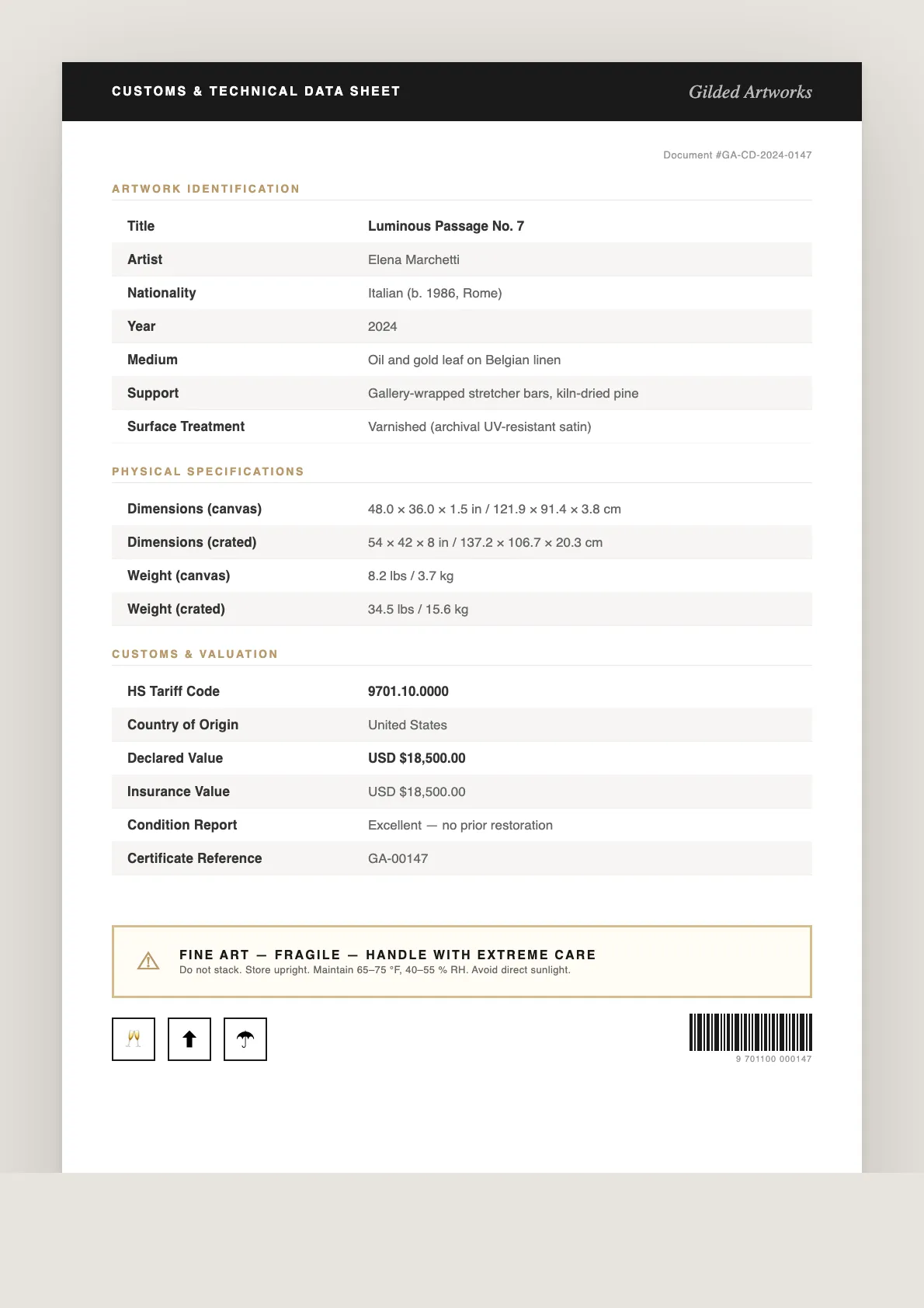
Document Type
Customs Documentation
International art shipments are held at the border for paperwork reasons far more often than for substantive ones, and the most common reason is a line that carries no tariff classification or the wrong one. Gilded Art Works produces a commercial invoice for the shipment: shipper and consignee blocks, one row per work carrying artist, year, medium, dimensions and declared value, an HS code classified from the medium on each row, and a signed declaration that names the codes actually used.
Best for: Galleries and dealers shipping across a border who need the classification decided and written down before the crate leaves, not argued about after it stops.

What’s in the document
- HS code classified per line from the medium and year you entered
- Ten Harmonized System codes across Chapters 49, 58, 69, 70 and 97
- Unrecognised media are marked "review" and carry no code — never a guess
- Shipper (exporter) and consignee (importer) blocks, with destination and carrier
- One row per work: artist, year, medium, dimensions, declared value
- Declared-value total for the whole shipment
- Signed declaration whose wording changes when any line needs review
What the document is and when it is required
Any commercial shipment crossing a customs border needs a commercial invoice: the document the importer, the broker and the customs authority all read to decide what the goods are, what they are worth and what duty applies. For fine art this is more consequential than for most goods, because the difference between two plausible classifications is often the difference between a duty-free entry and a dutiable one.
The invoice is not the customs entry. Your broker or the carrier’s brokerage arm files the entry, and in most jurisdictions only a licensed broker may do so. What they need from you is a complete, internally consistent description of the shipment, signed by someone at the exporter who is willing to stand behind it. That is what this document is.
The ten codes the classifier returns
Classification runs from the medium text and the year on each artwork record. It returns one of exactly ten Harmonized System codes, or no code at all. One rule to know before the list: a record with no medium entered returns no code at all, and that check runs before the antiques rule — so a work dated 1890 with the medium field left empty is flagged for review rather than classified as an antique. Where a medium is present, the antiques rule takes precedence over every other: anything dated more than a hundred years before the current year classifies as 9706.00 whatever the medium says.
- 9701.10 — Paintings, drawings and pastels, executed entirely by hand
- Matched on oil, acrylic, watercolour, gouache, tempera, encaustic, pastel, charcoal, graphite, pencil, conté, ink, fresco and casein. Mixed media reaches this code only when the medium text also names a hand-executed support — canvas, panel, board or paper.
- 9701.90 — Collages and similar decorative plaques
- Matched on collage, décollage and decorative plaque.
- 9702.00 — Original engravings, prints and lithographs
- Matched on the hand-pulled processes: etching, engraving, lithograph, serigraph, screenprint, silkscreen, woodcut, linocut, drypoint, aquatint, mezzotint, monotype, monoprint and intaglio.
- 9703.00 — Original sculptures and statuary, in any material
- Matched on sculpture, statuary, bronze, cast iron or metal, marble, carving, assemblage, installation and welded, steel or resin sculpture.
- 9706.00 — Antiques of an age exceeding one hundred years
- Applied on the year, ahead of every medium rule, when the work is more than a century old. It is the FIRST classification tested, so it outranks the reproduction and photograph rules below: a giclée dated 1900 classifies as an antique, not as a reproduction. The only thing that comes before it is the check for an empty medium field.
- 4911.91 — Photographs
- Matched on photographic processes: pigment print, C-print, chromogenic, gelatin silver, inkjet, archival print, platinum print, cyanotype, daguerreotype and tintype. Photographs sit in Chapter 49, not Chapter 97 — this is the single classification galleries most often get wrong, because a limited-edition photograph feels like a work of art and is not treated as one by the tariff.
- 4911.99 — Other printed matter (reproduction)
- Matched on giclée, reproduction, repro print, poster and offset. A giclée of a painting is a reproduction, not the painting, and this rule is checked before every other medium rule — ahead of photographs, prints, sculpture and painting alike. It sits behind only the antiques rule above.
- 6913.10 — Statuettes and other ornamental ceramic articles
- Matched on ceramic, porcelain, stoneware, earthenware and terracotta, where the work is not described as sculpture.
- 7013.99 — Glassware for indoor decoration
- Matched on art glass, blown glass, kiln and fused glass, and stained glass.
- 5805.00 — Hand-woven tapestries
- Matched on tapestry, hand-woven, woven wool and kilim.
What happens when the medium is not recognised
The classifier does not guess. If the medium text matches none of the rules above, the line prints "review" in red instead of a code, and the declaration block at the foot of the invoice changes: instead of declaring the goods classified under the codes shown, it tells you that one or more lines could not be classified, and instructs you not to sign until every line carries a code confirmed with your broker.
Three categories reach that state by design rather than by accident. A record with the medium field left empty returns no code, and this is tested first, before age — an antique with no medium entered is flagged for review rather than classified. Mixed media with no stated support returns no code, because the dominant material decides the classification and only you know what it is. Digital, screen-based, video, generative and AI-generated works also return no code, because what crosses the border is the physical object shipped — a print, a screen, a drive — and that object, not the work’s nature, is what gets classified.
Where shipments actually go wrong
The failure is rarely a wrong code chosen in bad faith. It is a mismatch between documents. The packing list says one set of dimensions, the invoice says another; the declared value on the invoice differs from the value on the insurance certificate; the medium on the certificate of authenticity reads "photograph" while the invoice classifies it under Chapter 97. Any one of those gives a customs officer a reason to stop the crate and ask a question, and questions asked at a border are answered slowly.
Generating the customs invoice and the shipping documentation from the same artwork records removes the transcription step where those mismatches are introduced. It does not remove the need to get the underlying record right in the first place.
What it does not do
It does not file your customs entry, calculate duty, VAT or import tax, or determine origin. It does not check whether your shipment needs a CITES permit — ivory, tortoiseshell, certain woods and feathers in an older work all raise that question, and it is one for your broker. It does not book carriage or buy a label; carrier rate shopping is not enabled on this deployment. And the code on the line is a classification proposal made from the words you typed. You are the one who signs the declaration, so read every line before you do.
Questions, answered
How does the HS classification work?
It reads the medium text and the year on each artwork record and matches them against ordered rules, returning one of ten codes. A record with no medium at all is flagged for review before anything else is tested. Otherwise antiques over a hundred years old are caught first as 9706.00, then reproductions as 4911.99, then photographs as 4911.91, then original prints, sculpture, collage, hand-executed painting, and finally ceramics, art glass and tapestry. Anything unmatched returns no code and is flagged for review.
Why is my limited-edition photograph not classified under Chapter 97?
Because the Harmonized System places photographs in Chapter 49 under 4911.91, not among works of art in Chapter 97. It is a tariff distinction, not an aesthetic judgement, and declaring a photograph as 9701 is a misdeclaration. If your specific circumstances argue otherwise, that is a conversation for your customs broker — override the code and record why.
Is this document accepted by UPS, FedEx and DHL?
It is a commercial invoice carrying the fields all three expect for fine art — shipper, consignee, description, artist, year, medium, dimensions, HS code and declared value, over a signed declaration. Every carrier still requires its own entry to be completed in its own system by you or your broker. This document gives them what they need without a phone call; it does not replace their filing.
Can I document a multi-artwork shipment?
Yes. Every work you add becomes a row on the invoice, classified on its own medium, with a declared-value total for the shipment. A crate holding a bronze, an etching and a photograph will show three different HS codes and a declaration listing all three.
Can I override a code the classifier suggests?
The classification is derived from the medium text, so the way to change it is to describe the medium accurately and regenerate. Where you and your broker conclude a different code applies, mark the correction on the invoice before filing and keep a note of the reasoning with the shipment file.
Also in the library
Your first customs documentation is free.
One artwork entry, any of the 15 document types. Three a month on the free plan, no card required.
Create Your First Document — Free