
Document Type

Artist Statement

The statement is where the work speaks in words, and where presentation either honours it or undercuts it. Gilded Art Works lays out a single statement page to editorial standard: the artist’s name and medium set as a title block, then ruled sections for the statement itself, biography, education, exhibitions, collections and awards, closing on a list of works referenced and the gallery’s contact details. The platform sets the page and supplies the structure; the words are yours to write.

Best for: Galleries preparing exhibition materials, and artists who want their words presented as seriously as their work.
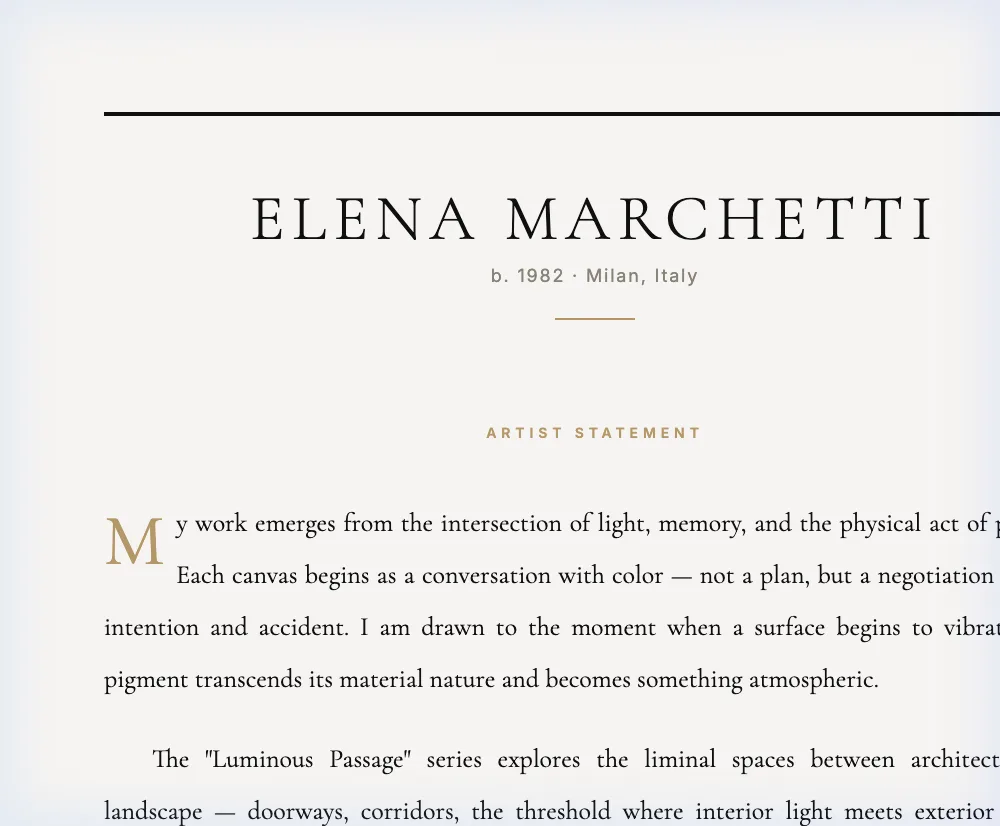
Artist Statement — generated example
Generated by the platform from a sample gallery and sample artworks. Where the document leaves a ruled blank for a value only a person can supply — an underwriter, a conservator’s findings, a buyer’s signature — the example shows the blank.

What’s in the document

  • Title block with the artist’s name and the medium of the first work listed
  • A 150-pixel ruled statement area, prompted for the artist’s own words
  • Sections for biography, and for education and training
  • Sections for selected exhibitions, collections, and awards and residencies
  • Works-referenced list drawn from your artwork entries, up to six works
  • Gallery name, address and contact in the closing block, with the date
  • Print-ready at A4, US Letter, A3 or A5

What the page is for

The artist statement is the one document in this library that is read rather than filed. It goes into a fair booth, an exhibition handout, a submission packet, a press pack and a collector’s folder, and in each of those places it is competing for about forty seconds of attention against everything else on the table.

It is also the document galleries most often present badly. A statement typed into a word processor, printed on office paper and photocopied does not fail because of the words; it fails because everything around the words says the gallery did not think this mattered. Setting it as a designed page — with the gallery’s identity on it, in the same typographic voice as the certificate and the catalog — costs nothing after the writing is done and changes how the writing is received.

How the page is structured

The layout is a title block, one large area for the statement, then a set of shorter ruled sections in the order a reader scans them.

Title block
The artist name from your gallery profile — or from the first artwork record where the profile has none — set large under an Artist Statement label, with the medium of the first work beneath it. Centred, above a double rule.
The statement
The largest area on the page, prompted with what belongs in it: in the artist’s own words, what the work is about and why it is made this way. Its size is a deliberate instruction — a statement that fills it is roughly the right length, and one that leaves most of it empty is usually a paragraph of biography wearing a statement’s title.
Biography, education and training
Biography runs full width; education and training sits in a two-column band beside selected exhibitions. Facts go here so that the statement above can stay about the work.
Exhibitions, collections, awards and residencies
Four short sections across two bands. These are the lines a collector’s adviser scans for institutional weight, and they are read as a list rather than as prose.
Works referenced
Up to six works from your artwork entries, each printing title in italic with year, medium and dimensions. It is capped at six because the page is one page and a longer list turns the statement into a checklist.
The closing block
Represented by, with the gallery name and address, and the contact email and date at the right. It makes the page usable on its own when it is separated from everything it arrived with — which it will be.

Writing into the space

Two habits produce statements that survive being read. The first is to write about what is in front of the viewer before writing about what it means: the material, the process, the decisions that are visible in the object. A reader who can see the work described in the words trusts the interpretation that follows; one who cannot has been asked to take the whole thing on faith.

The second is to cut the vocabulary that belongs to no particular artist. A statement that would sit equally well under a different artist’s name has failed, however well written, because the one thing it had to do was distinguish this practice from every other one. The test is blunt and it works: cover the name at the top, hand the page to someone who knows the field, and see whether they can tell whose it is.

What it does not do

It does not write anything. Every section prints as a ruled blank, including the biography — the platform has no basis on which to write an artist’s life, and generating one would be inventing a person’s history. It is not a text engine: it does not take a block of prose and typeset variants of it. It produces one format, a single page, and it does not fit long copy for you — writing that overruns is edited down rather than reflowed. And it does not check anything you claim; exhibitions, collections and awards print as entered.

Questions, answered

What format does the statement come in?

One format: a single print-ready page in your gallery’s branding, which opens in a browser tab for you to print or save as a PDF. The artist’s name and medium head the page, followed by ruled sections for the statement, biography, education, exhibitions, collections and awards, then the works referenced and your contact block. It is not a text engine and does not typeset variants of a block of prose.

Does it write the artist bio?

No. There is a dedicated biography section alongside education and training, and it prints as a ruled blank. The platform has no basis on which to write an artist’s life, so it does not attempt to — a generated biography would be an invented one.

Can each exhibition have its own statement?

Generate the document as many times as you need — once per exhibition, once per artist, or both. Each generation is its own page with its own document number, and nothing overwrites anything.

Why does the works-referenced list stop at six?

Because the document is one page. Beyond six entries the list starts to displace the statement, and the page becomes a checklist with an introduction. If you need a longer list of works, that is what the editorial catalog is for.

Also in the library

Your first artist statement is free.

One artwork entry, any of the 15 document types. Three a month on the free plan, no card required.

Create Your First Document — Free