Document Type
Provenance Record
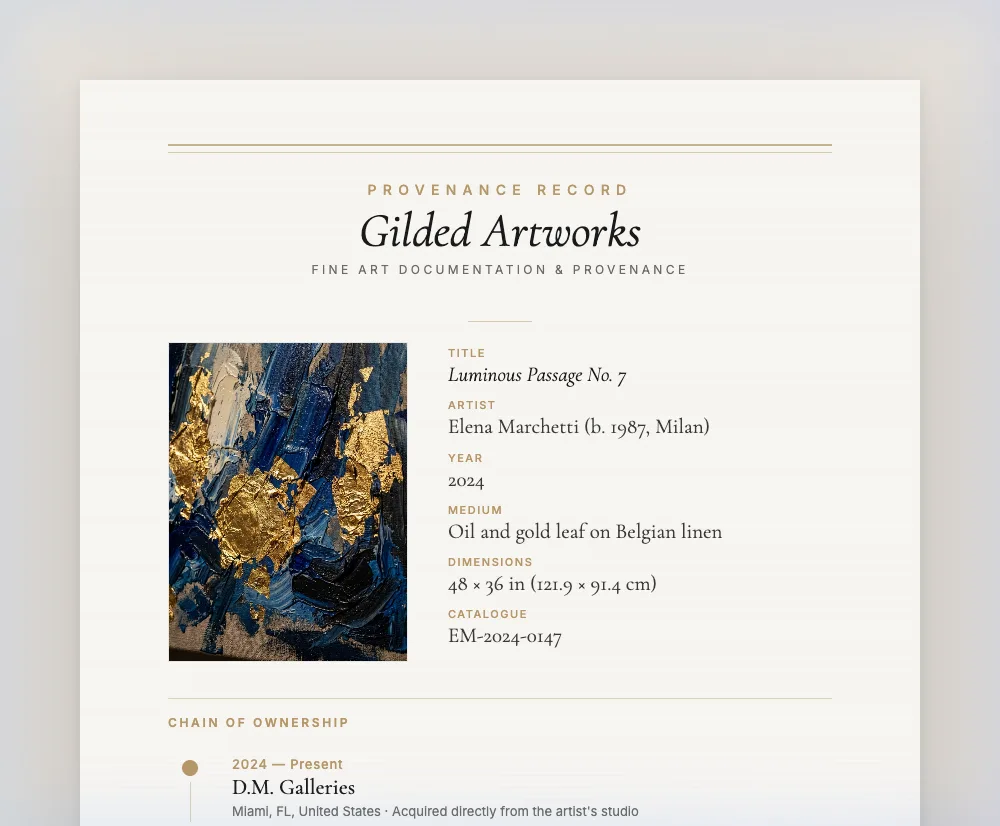
Provenance is the part of an artwork’s file that takes years to assemble and minutes to lose. Gilded Art Works prints the register that holds it: the works identified with their images and details, then an ownership table with columns for period, owner or custodian, location, the party acquired from, and notes — opened with the current custodian and closed with a line stating that further entries are for your registrar to complete, under a compiled-by signature.
Best for: Galleries handling estates or secondary-market works, registrars maintaining an ownership file, and anyone assembling the paperwork ahead of a consignment.

What’s in the document
- The works identified with image, title, artist, year, medium and dimensions
- Ownership table: period, owner or custodian, location, acquired from, notes
- Current custodian entered from your gallery profile and badged as current
- A closing line stating that additional entries are to be completed by the registrar
- Compiled-by signature line with a gallery seal
- Document number and date of compilation in the header; number again in the footer
What provenance is, and what it is worth
Provenance is the documented history of who has owned a work, from the artist’s studio to the present holder. Auction houses, insurers and serious private buyers examine it because it addresses three separate questions at once: whether the work is what it is said to be, whether the seller can actually pass good title, and whether the work has a history that would make owning it a problem.
That third question is why provenance research became a professional discipline rather than a courtesy. Works displaced during the Second World War, works removed from archaeological sites, works that left a country in breach of its export law — all of them surface as gaps in an ownership chain, and a gap covering the wrong decades will stop a consignment or a sale outright. The trade’s working assumption is that an unexplained gap is a question, not an oversight.
What this document actually contains
Be clear about what you are getting, because provenance is the area where documentation software most often oversells. This is a register, not a research service.
- The works
- Each work you include prints with its image, title, artist, year, medium and dimensions, so the record is attached to identifiable objects rather than to titles alone.
- The ownership table
- Five columns — Period, Owner / Custodian, Location, Acquired From, Notes. One row is written for you: the current year to present, your gallery, your address, badged Current. Beneath it runs a single full-width line reading that additional provenance entries are to be completed by the registrar. That line is a statement, not a set of ruled cells — earlier links go on by hand, in a PDF editor, or by recording them in your own file and regenerating.
- The compiled-by block
- A signature line naming your gallery as compiler, with the gallery seal. The document says who assembled the record and on what date — which is the honest framing, because a provenance record is a compilation, and the compiler’s identity is part of the evidence.
- Number and date
- The document number and the compilation date print in the header; the number repeats in the footer alongside your gallery name and contact address. The footer carries no date, so a page separated from its header is identified by number rather than by version — a provenance record is superseded as often as it is amended, and the number is what tells two copies apart.
How to fill a chain in without damaging it
Work backwards from the present, and record each link with the evidence that supports it — an invoice, a bill of sale, a shipping record, a catalogue entry, a letter, a photograph of the work hanging in a named room. Where you have no evidence for a link, write the gap down as a gap. "Private collection, Paris" is an acceptable entry when it is what a vendor stated and you say so; it becomes a problem when it is written as if the gallery established it.
The single most damaging habit in provenance work is smoothing. A chain that reads continuously because plausible entries were inserted to close a gap is worth less than a chain with an honest hole in it, because the first one collapses entirely the moment any single invented link is tested. This document prints only the link it can stand behind, says on its face that the rest is outstanding, and names who compiled it — precisely so that the distinction between what you know and what you were told stays visible on the page.
What it does not do
It does not research provenance, verify any entry, or check a work against a stolen-art register — searches of the Art Loss Register, national databases and the relevant restitution records are separate work, usually paid, and nothing here substitutes for them. It does not extend itself automatically as you record sales; each regeneration prints the current custodian and the same standing line about outstanding entries, and it prints no ruled cells for you to write earlier links into. It does not carry exhibition history or literature references — the exhibition history document is the register for those. And it does not cross-link to the certificate or bill of sale; keeping those together under one file is a discipline you maintain, not a feature.
Questions, answered
Does the record research provenance for me?
No. It prints the register, opens it with your gallery as current custodian, and states on the page that further entries are for a registrar to complete. Establishing prior ownership is research — archives, invoices, catalogues, correspondence — and it is neither automated nor verified here.
What do I do about a gap in the chain?
Record it as a gap. A chain with an acknowledged hole in it is worth more than one closed with plausible entries, because a single invented link discredits the whole record when it is tested. Where an entry rests on a vendor’s statement rather than a document, say so in the notes column.
Does the record update itself when I sell a work?
No. Each generation prints the current custodian from your gallery profile and the same standing line about further entries. Recording a transfer means adding the entry to your own file and regenerating — the document number and the date in the header tell you which version a reader is holding.
Does it include exhibition history and literature?
No. The ownership table covers period, custodian, location, source and notes. Exhibition history is a separate document type here, and literature references belong with it.
Does it check the work against stolen-art databases?
It does not. Due-diligence searches against the Art Loss Register, national police databases and restitution records are separate, usually paid work, and they are not performed or implied by this document.
Also in the library
Your first provenance record is free.
One artwork entry, any of the 15 document types. Three a month on the free plan, no card required.
Create Your First Document — Free